
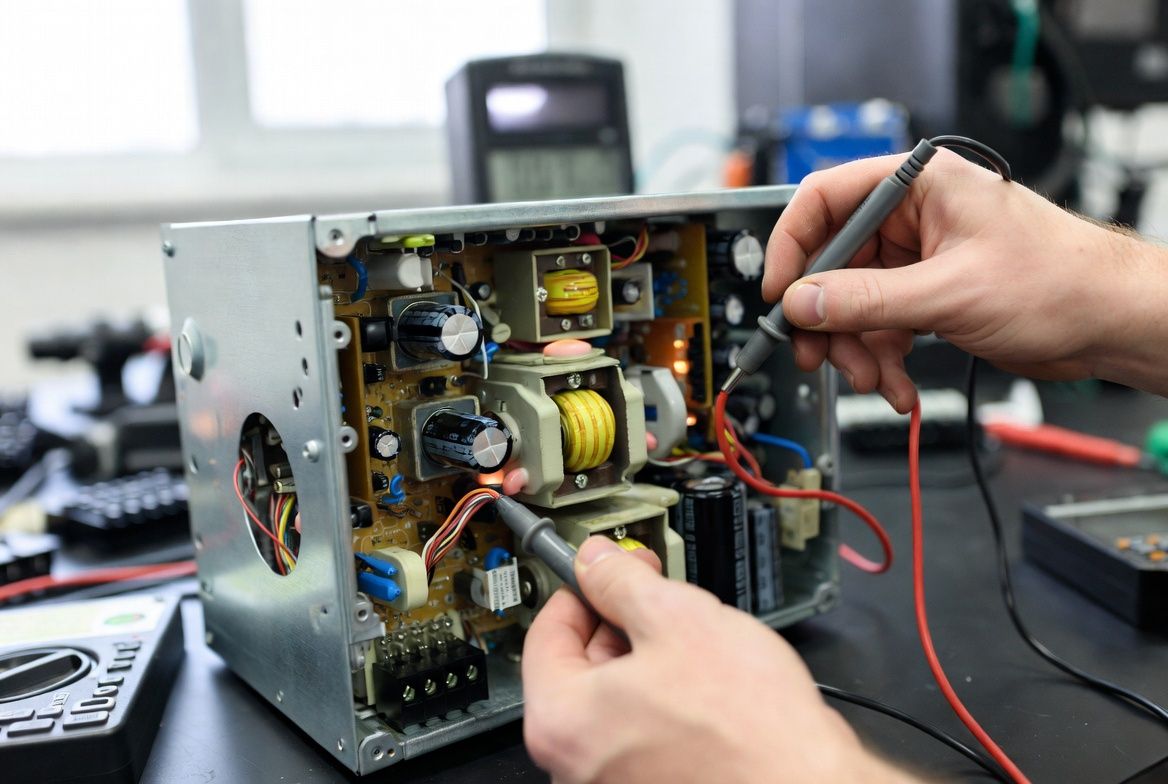
Picture this scenario. Your equipment suddenly cuts out, restarts on its own, or starts behaving erratically, and you are left staring at it, wondering what just happened. Nine times out of ten, the culprit is hiding somewhere in the power supply, and most people do not even think to look there first.
Whether you are dealing with industrial equipment, lab instruments, or test systems, AC power supply issues are some of the most common and most overlooked sources of downtime. The good news is that most problems follow recognizable patterns once you know what to look for. Let’s walk through the usual suspects and how to track them down.
Symptom: Unstable or Fluctuating Output Voltage
If your equipment is acting unpredictably, randomly resetting, dimming, or behaving differently depending on the time of day, an unstable AC power supply is often to blame. This can stem from an overloaded circuit, a failing voltage regulator inside the unit, or fluctuations coming from the utility griditself. Start by checking the output voltage with a multimeter under both light and heavy load. If the voltage swings wildly between the two readings, the supply itself may be struggling to keep up with demand. Suppliers such as BOS Power build programmable AC power supplies with active voltage regulation specifically to minimize these kinds of fluctuations.
Symptom: Overheating or Thermal Shutdown
An AC power supply that keeps shutting down after running for a while, especially in warm environments, is almost always a heat-related issue. Check that ventilation paths are clear, cooling fans are spinning freely, and the unit is not tucked into a cabinet with no airflow. Dust buildup on heat sinks is one of the simplest things to overlook and one of the easiest to fix. A quick clean and a few inches of breathing room can solve more thermal issues than you would expect.
Symptom: Unexpected Shutdowns or Tripping
When an AC power supply trips repeatedly, the first thing to check is whether the load connected to it has changed recently. New equipment, added cables, or a recently modified setup can push current draw past what the supply or its protection circuits are rated for. It is also worth checking for loose or corroded connections, since a poor connection can cause intermittent faults that look like the power supply itself is failing when the real issue is just a bad contact point.
Symptom: Strange Noises or Smells
Buzzing, humming, or a faint burning smell coming from your AC power supply should never be ignored. These are often early warning signs of a failing transformer, a capacitor nearing the end of its life, or components running hotter than they should. If you notice any of these signs, it is worth shutting the unit down and having it inspected before a minor issue turns into a complete failure, or worse, a safety hazard.
When to Repair vs. Replace
Not every AC power supply problem means you need a brand new unit. Issues caused by dust, loose connections, or simple component wear can often be repaired relatively cheaply. However, if you are dealing with an older unit that has already had multiple failures, or if repairs are starting to cost a significant percentage of a replacement, it is usually more cost-effective in the long run to upgrade to a newer, more efficient model with better protection features built in.
Troubleshooting an AC power supply does not have to feel like guesswork once you know the common patterns to look for. Voltage instability, overheating, tripping, and unusual noises each point toward specific causes, and catching them early can save you from costly downtime. If your current setup keeps giving you trouble, manufacturers such as BOS Power design rugged AC power supplies built for demanding industrial and testing environments, and upgrading might be the simplest fix of all.